


National Education
Education Bureau website
Recognize the national flag, national emblem, national anthem, and regional flag.
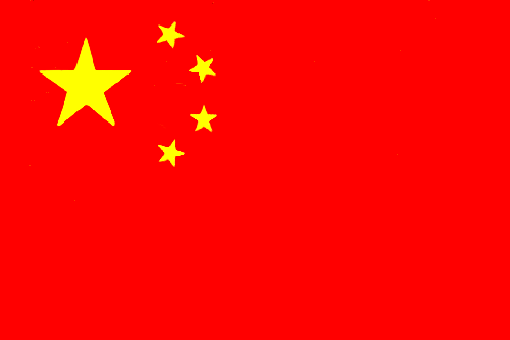
(I) National Flag
On June 16, 1949, the Preparatory Committee for the New Political Consultative Conference decided to establish a Preliminary Selection Committee for the National Flag and Emblem Designs, and published a call for submissions in newspapers such as the *People's Daily* from July 14 to August 15 of that year. During the First Plenary Session of the Chinese People's Political Consultative Conference in September 1949, the Preliminary Selection Committee selected 38 designs from the 3,012 submitted designs and distributed them to all delegates for discussion. On September 27, 1949, the delegates to the First Plenary Session of the National Committee of the Chinese People's Political Consultative Conference passed a resolution to adopt the Five-Starred Red Flag as the national flag.
The red color of the national flag of the People's Republic of China symbolizes revolution. The five five-pointed stars on the flag and their relationship symbolize the great unity of the revolutionary people under the leadership of the Communist Party. The stars are yellow to make them stand out against the red background; yellow is brighter and more beautiful than white. Each of the four smaller stars has one point facing the center of the larger star, representing unity around a central point, and also creating a compact and aesthetically pleasing form.
(II) National Emblem
On June 28, 1950, the Eighth Meeting of the Central People's Government Committee adopted the "Design of the National Emblem of the People's Republic of China and Explanation of the Design" proposed by the Second Session of the First National Committee of the Chinese People's Political Consultative Conference. On September 20 of the same year, Mao Zedong, Chairman of the Central People's Government, issued the "Order of the Central People's Government," announcing the national emblem and its design explanation.
The design of the national emblem was officially stipulated in the 1954 Constitution of the People's Republic of China. The emblem features Tiananmen Square under five stars in the center, surrounded by ears of grain and gears. This design remains in use to this day.
(III) National Anthem
The national anthem of the People's Republic of China is "March of the Volunteers." Originally, "March of the Volunteers" was the theme song of the 1935 film "Children of Troubled Times," a film about resisting Japanese aggression and saving the nation. The lyrics were written by playwright Tian Han, and the music was composed by renowned musician Nie Er (see footnote). The original story of "Children of Troubled Times" was created by Tian Han. This film depicts the heroic story of young people in the early 1930s who went to the front lines to save their motherland from the Japanese invasion.
The 1930s marked the beginning of the War of Resistance against Japan in modern Chinese history, bringing the entire Chinese nation to a critical juncture of life and death. In 1931, under Japanese militarism, the Imperial Japanese Army launched the "September 18 Incident," occupying Northeast China and igniting fierce resistance from the Chinese people. Various anti-Japanese activities arose among the people, promoting the message of uniting to face the national crisis and resist Japan for national salvation in different ways. Among them, the "March of the Volunteers," composed by Tian Han and Nie Er, with its clear rhythm, soaring melody, and powerful expression, embodies the indomitable fighting spirit of the Chinese nation.
"The March of the Volunteers" became widely popular throughout China after its premiere in May 1935 with the film "Children of Troubled Times." On September 27, 1949, the First Plenary Session of the Chinese People's Political Consultative Conference passed a resolution that, before the official formulation of the national anthem of the People's Republic of China, "The March of the Volunteers," with lyrics by Tian Han and music by Nie Er, would serve as the provisional national anthem. On October 1, 1949, the Central People's Government of the People's Republic of China was established. On Tiananmen Square in Beijing, as the five-starred red flag rose, "The March of the Volunteers" resounded for the first time.
(iv) Regional flag
The regional flag is a red flag with a dynamic bauhinia flower pattern featuring five stars in the center. The red flag represents the motherland, and the bauhinia flower represents Hong Kong, symbolizing that Hong Kong is an inseparable part of China and prospers in the embrace of the motherland. The five stars on the flower's stamen symbolize the love of Hong Kong compatriots for the motherland, and the red and white colors embody the spirit of "one country, two systems."


March 22, 2024: Form 4 and Form 5 Film Appreciation: Ping Pong: The Triumph (China's Table Tennis Team's Comeback)
Yesterday, over a hundred teachers and students flocked to see the newly released sports film, " #China's Table Tennis: The Comeback ." Teacher Tan Chaoqun, who led the group, explained the film's background to the students beforehand, pointing out that the history of Chinese table tennis is connected to Wu Shaomei. Rong Guotuan , China's first world table tennis champion, was a Hong Kong player who grew up in the Shau Kei Wan wooden shantytown and attended Salesian Secondary School , which belonged to the same educational group as Wu Shaomei Secondary School.
The principal hopes that students will demonstrate this spirit of perseverance in their studies and all aspects of life, and that even if they start later than others, they can still overcome their limitations with persistence and never giving up. China has indeed made many outstanding contributions in sports, archaeology, and paleontology research, which is evident to the world and beyond doubt. The students believe that true patriotism should be based on empathy, mutual respect, and rational and balanced expression of opinions.


Morning Meeting Sharing (April 17, 2024): 129th Anniversary of the Treaty of Shimonoseki
During morning assembly, the Moral and Civic Education Section of our school gave a short talk to students on the 129th anniversary of the Treaty of Shimonoseki, highlighting the relationship between modern China and the great powers, and the impact of unequal treaties on national development. Through this talk, the section hopes to increase students' sense of national identity and their awareness of national security.


February 28, 2024
Lee Ching Education Center's "How Much Do You Know About National Development?" Project School Seminar
Theme: China's Path to Innovation
On this day, Dr. Su Zhiqi, Chairman of the Politics and Human Resources Foundation, was invited to our school to host a lecture. Dr. Su's topic was "China's Path to Innovation," aiming to help students understand the history, hardships, and achievements of the nation's innovation efforts, as well as the difficulties, challenges, and future prospects. Dr. Su's richly illustrated and insightful analysis gave students a deeper understanding of the nation's scientific research development. At the same time, it commemorated the early days of the nation, when researchers worked tirelessly and painstakingly to cultivate the vast land of the Republic; time has passed, and a new era has dawned!


Morning meeting sharing on September 16, 2024: The September 18 Incident
Former President of the People's Republic of China, General Secretary of the Communist Party of China, and Chairman of the Central Military Commission, Mr. Jiang Zemin, passed away peacefully in Shanghai on November 30, 2022, at the age of 96. A national memorial service was held at 10:00 AM on December 6. Following the instructions of the Education Bureau, our school arranged for all teachers, students, and staff to observe three minutes of silence at 10:00 AM that day to mourn alongside compatriots across the country. Furthermore, a brief introduction to President Jiang Zemin's life and achievements was given to all students during the morning assembly that day.
The Moral and Civic Education Group of our school conducted a short talk on the September 18 Incident during the morning assembly, in order to increase students' understanding of the suffering brought about by the War of Resistance against Japan, cultivate students' national identity, and foster students' appreciation for peace and the value of national military security.


Weekly Meeting, November 13, 2024: National Security Education Seminar
Our school is honored to have invited Attorney Liu Jianyi (Gold Bauhinia Star, Justice of the Peace) to share a lecture on national security education with all faculty and students. Through this lecture, students will learn about the basic concepts of national security, the various aspects of national security, and information about national security laws. This will cultivate students' awareness of national security and their spirit of abiding by the law.


Morning Meeting Sharing (March 12, 2025): Centenary of Dr. Sun Yat-sen's Death
On the occasion of the centenary of the death of Dr. Sun Yat-sen, the pioneer of the revolution, the school's Moral Education and Civic Education Department arranged a morning meeting to share with students a brief introduction to Dr. Sun Yat-sen's life and deeds.


"Hug the Giant Panda" Interdisciplinary Activity, March 26-27, 2025
The school library will hold a "Hug the Giant Panda" event in March 2025. In addition to booth games and book presentations organized by other subject groups, the Moral Education and Civic Education Group will also conduct a sharing session on national security and the giant panda during the morning assembly during the event. It is hoped that through the adorable image of the giant panda, students will gain a deeper understanding of the importance of national security, and at the same time, in conjunction with the United Nations Sustainable Development Goals, enhance students' awareness of environmental protection and social responsibility.


