


Non-Chinese Language Department
The undergraduate program is designed for non-Chinese speaking students, offering a progressive and practical Chinese language curriculum tailored to their daily lives.
The junior high school curriculum focuses on rebuilding foundations and building confidence, covering everyday topics such as "introducing oneself" and "food and environment," and is supplemented with diverse teaching materials such as picture books, Chinese alphabet teaching, and adjustment worksheets. The subject group has also specially compiled a "one word a day" self-study manual and mobile application to facilitate students' independent learning and solidify their language foundation.
The senior secondary curriculum is geared towards further education and employment, aligning with IGCSE examination requirements. In addition to covering advanced units, the curriculum introduces a pioneering "Professional Chinese" school-based unit, arranging visits to different schools and companies to learn workplace communication, resume writing, and interview skills. The department also leverages information technology, developing applications and social media to comprehensively enhance the Chinese listening, speaking, reading, and writing abilities of non-Chinese speaking students, helping them integrate smoothly into Hong Kong society and paving the way for their future development.
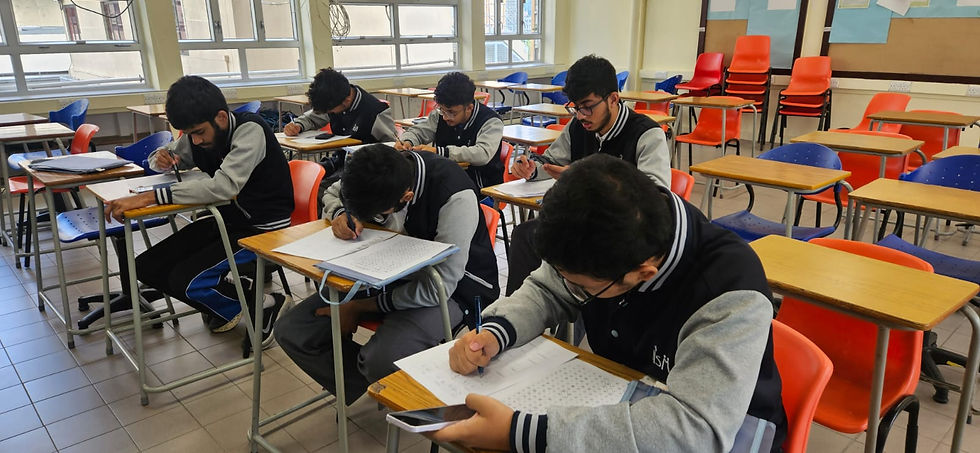
學生在課堂上專心進行寫作與閱讀練習,透過結構化教材與自主學習鞏固語文基礎。

學生參與社區文化考察活動,走出課堂親身體驗本地漁村風貌,拓展學習視野。
1. Curriculum Design
1.1 Concept and Objectives
The aim of our school's non-Chinese speaking Chinese teaching is to help ethnic minorities integrate into society, provide non-Chinese speaking students with an important language foundation for their studies and life in Hong Kong, and through Chinese learning, enable non-Chinese speaking students to understand and learn about Chinese culture, thus promoting their holistic development.
1.2 Addressing Learning Differences


Non-Chinese speaking students exhibit significant differences in their Chinese proficiency due to differences in race, age of enrollment, and length of residence in Hong Kong. Therefore, our school has designed a school-based curriculum that divides students into four levels across grade levels to ensure that the curriculum is tailored to students' learning abilities and needs.


1.3 Integrating into Society
The junior secondary curriculum focuses on everyday communication and relatable topics, enabling students to accumulate sufficient vocabulary and facilitating their integration into local society. The senior secondary curriculum includes a vocational Chinese school-based curriculum, tailored to students' interests and needs, teaching commonly used workplace vocabulary and comprehensively addressing their future needs for long-term residence, further education, or employment in Hong Kong.


2. Teaching Resources
2.1 "One Word a Day" Learning Manual
To cater to the learning needs of non-Chinese speaking students, the teaching team compiled a "One Word a Day" learning manual, which is designed to complement the school curriculum and includes 27 units covering a wide range of common words and phrases in daily life. Each set of words includes Chinese, English, and Udu translations, along with example sentences in both Chinese and English, to cultivate students' independent learning abilities.

2.2 Chinese Alphabet Input Method
Our school has incorporated "Chinese Alphabet Writing Tips" into the junior secondary curriculum, which breaks down Chinese characters into 21 letters to help students memorize the shapes and stroke order of characters, making their Chinese learning more efficient.


2. Teaching Resources
2.1 "One Word a Day" Learning Manual
To cater to the learning needs of non-Chinese speaking students, the teaching team compiled a "One Word a Day" learning manual, which is designed to complement the school curriculum and includes 27 units covering a wide range of common words and phrases in daily life. Each set of words includes Chinese, English, and Udu translations, along with example sentences in both Chinese and English, to cultivate students' independent learning abilities.
2.2 Chinese Alphabet Input Method
Our school has incorporated "Chinese Alphabet Writing Tips" into the junior secondary curriculum, which breaks down Chinese characters into 21 letters to help students memorize the shapes and stroke order of characters, making their Chinese learning more efficient.


(The successful teaching experience was featured in a special report by Hong Kong 01.)


(During a Sunday interview with our school, we shared how the "Chinese Alphabet Writing Tips" can help non-Chinese speaking students overcome difficulties with Chinese.)
3. Diversified teaching models
3.1 mLang
mLang is a teaching tool that helps non-Chinese speaking students learn Chinese. It provides students with opportunities for real-world learning, and teachers design teaching activities based on the school's Chinese curriculum, combining text, audio, and images to help students build a large vocabulary, lay a solid foundation for their language learning, and improve teaching effectiveness.


3.2 Joint School Cultural Experience Activities
Our school, in collaboration with three partner schools, organized a cultural experience activity aimed at giving students a deeper understanding of Hong Kong culture, expanding their social circles, and making it easier for them to integrate into local life.


4. Academic Performance
4.1 GCSE Results
Over the past three years, our students have achieved outstanding results in the GCSE examinations, with an average of over 65% of students achieving an A or higher grade each year, and a pass rate of over 95%.

(The student achieved excellent results in the GCSE exams.)
5. Professional team
5.1 The University of Hong Kong Professional Support Scheme
Our school collaborates with the University of Hong Kong, and through the University of Hong Kong's support services, we combine research-based teaching methods and classroom practice to address students' learning differences.
5.2 Language Teaching Support Team of the Education Bureau
Our school collaborates with the Language Teaching Support Group of the Education Bureau to optimize the curriculum based on the Education Bureau's Chinese Language Curriculum Second Language Learning Framework, establishing clear learning and assessment objectives for teaching materials and notes; and adapting Chinese teaching materials to allow non-Chinese speaking students to integrate into the mainstream curriculum.

(Ms. Lu Zhongyu and her team of teachers from the Language Teaching Support Group of the Education Bureau.)
5.3 Teacher Qualifications
The professional teaching team has ten years of experience teaching non-Chinese speaking students, and more than 70% of the teachers have received professional training in teaching non-Chinese speaking languages. The school continues to promote the professional development of Chinese teachers in teaching non-Chinese speaking students and improve the overall teaching level.


(The teaching team has published a paper, which is included in "Chinese Teaching for Chinese Learners - Theory and Practice" edited by Dr. Lin Weiye.)